
Security
Nigerian Army Deploys 178 Soldiers to Mangu Plateau State.

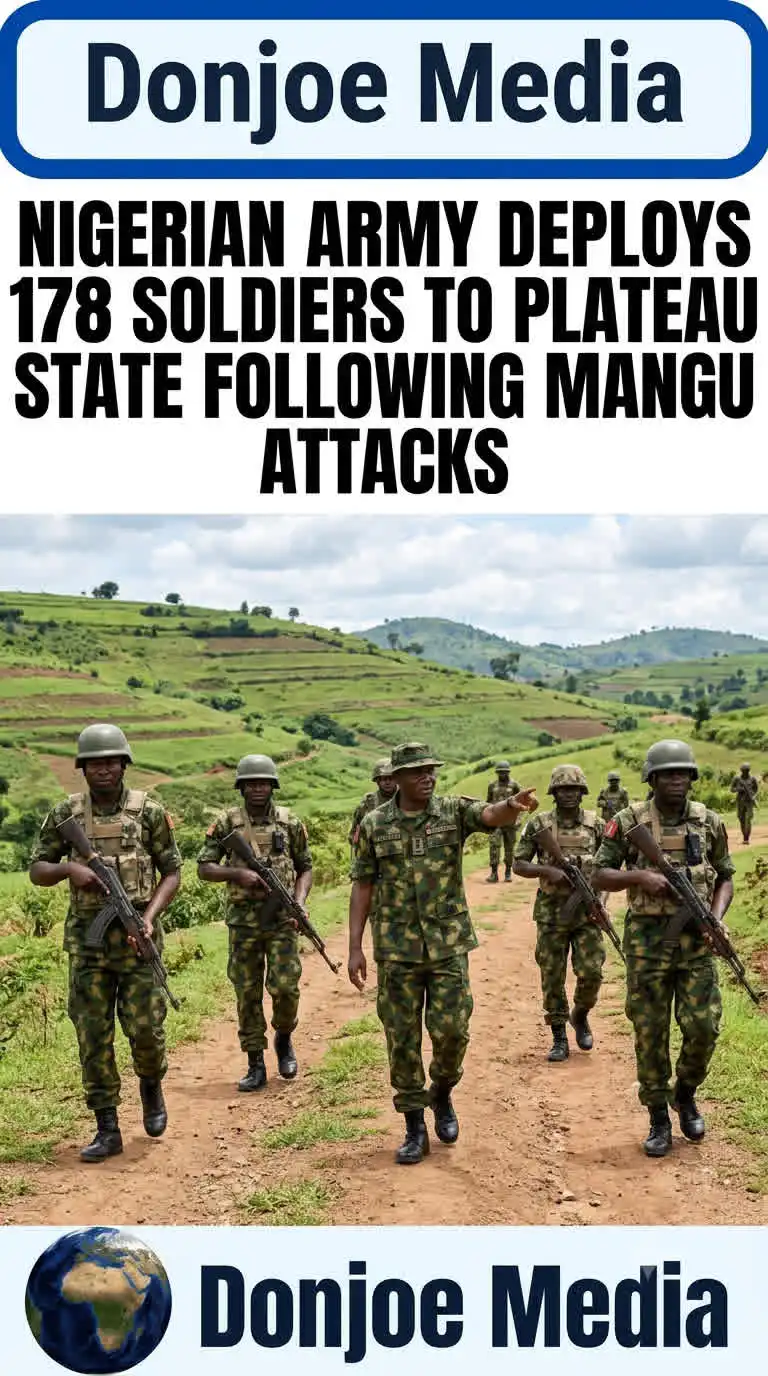
Published Date: September 29, 2026 Publisher: Donjoe Media
Nigerian Army Deploys 178 Soldiers to Mangu, Plateau State Under Operation Enduring Peace
MANGU, Plateau State — The Nigerian Army has deployed 178 troops to reinforce security operations in Mangu Local Government Area of Plateau State as part of ongoing efforts to restore peace in troubled communities.
The deployment, which took place at about 4:40 p.m. on September 25, 2026, involved personnel from the 236 Tank Battalion to Headquarters Sector 8, Operation Enduring Peace (OPEP) in Mangu.
According to an operational report from the Nigerian Army Headquarters in Abuja and security analyst Zagazola Makama, the troops were deployed in two groups of 89 personnel each, making a total of 178 soldiers. The deployment was led by the Commanding Officer of the 236 Tank Battalion, Lt. Col. H.O. Obire.
The troops were received on arrival by the Commander, Sector 8 OPEP, at the sector headquarters. Upon reception, the newly deployed personnel immediately commenced familiarization with the Area of Responsibility (AOR) and the operational mandate of the sector.
Security sources said the reinforcement is part of the recent restructuring of the Nigerian Army aimed at improving operational structure and response capacity in Plateau State.
The development comes amid heightened security concerns in parts of Mangu and adjoining communities, where several attacks, killings, livestock destruction and reprisal incidents have been reported in September. Communities in Mangu, Barkin Ladi, Riyom and Bokkos Local Government Areas have witnessed renewed violence in recent weeks.
Residents in affected villages said armed assailants have targeted isolated settlements, mostly at night, burning homes and destroying farms. Hundreds of families have been displaced and are currently taking shelter in makeshift camps in neighbouring towns. Local vigilantes and community leaders have called for increased military presence to deter further attacks.
The Nigerian Bar Association (NBA) branches in Jos, Pankshin, Bukuru and Shendam, at a joint press conference at the NUJ Secretariat in Jos, said the recurring attacks had exposed serious gaps in the state’s security response. The lawyers said attacks had continued even after curfews were imposed in some affected areas, citing the killing of community vigilantes at their duty post in Kikyo, Mangu Local Government Area, during curfew hours.
The NBA also cited reported attacks in Cantoma and Bin-Per communities in Mangu, and in Kasa village in Marit District of Barkin Ladi, stating that the unabated cycle of violence undermines public confidence.
Military authorities said the additional personnel are expected to strengthen ongoing security operations, improve troops’ presence in vulnerable areas and enhance the capacity of the sector to respond to emerging threats. The troops are also expected to work with other security and response elements operating within the area to protect civilians, prevent further attacks and maintain security across communities within the sector’s Area of Responsibility.
Operation Enduring Peace (OPEP), formerly known as Operation Safe Haven (OPSH), is the Nigerian Army’s internal security operation responsible for maintaining peace in Plateau State and parts of Bauchi and Kaduna States. The operation was established to tackle communal clashes, banditry, farmer-herder conflicts and other security challenges in the North Central region.
Security analysts say Mangu LGA has remained a flashpoint due to its difficult terrain, isolated communities and recurring communal tensions. The deployment of troops from the 236 Tank Battalion, a combat unit equipped for mobile operations, is expected to improve patrol coverage and rapid response.
Residents who spoke to Donjoe Media welcomed the deployment, expressing hope that the increased military presence would restore confidence and allow displaced persons to return to their homes and farms. Community leaders urged the troops to work closely with local vigilantes and traditional institutions for intelligence gathering.
The Nigerian Army has not released an official statement on casualties or recoveries from the recent operations, but sources said clearance patrols and confidence-building patrols are ongoing.
Donjoe Media will continue to monitor the security situation in Plateau State and provide updates on Operation Enduring Peace activities.
This report was compiled with information from Nigerian Army Headquarters, Zagazola Makama security reports, and NBA Plateau branches.
The deployment falls under the ongoing military exercise known as Operation Hakorin Damisa IV. This operation was specifically designed to tackle the unique security challenges on the Plateau. The newly deployed troops are not going in light. They are backed by eight specialized Armoured Personnel Carriers. These heavy vehicles will provide vital protection and mobility. They will allow soldiers to safely navigate the difficult terrain of the Mangu hinterlands.
Military commanders deeply understand the urgency of the situation. The recent attacks in Mangu were swift and brutal. Armed assailants targeted isolated villages late at night. The attackers burned homes and looted local food reserves. Many innocent lives were lost in the chaotic crossfire. Hundreds of families had to flee their ancestral homes with nothing but the clothes on their backs. They are currently taking shelter in makeshift camps in neighboring towns.
The arrival of the 178 soldiers brings a glimmer of hope to these traumatized residents. Their primary mission is to intensify mobile patrols across the entire local government area. The Armoured Personnel Carriers will be stationed at strategic flashpoints. This visible military presence is meant to strongly deter further attacks. It sends a clear message to the armed groups operating in the shadows. The era of unchallenged raids in Mangu is coming to an end.
Restoring physical security is only the first immediate step. The Nigerian Army also faces the heavy task of rebuilding public trust. Residents of Mangu have felt deeply abandoned during previous waves of violence. The delayed response times in the past left communities highly vulnerable. To fix this, the new troop deployment includes a strong community engagement strategy. Soldiers have strict orders to work closely with local community leaders. They must rely on grassroots intelligence to anticipate and prevent future strikes.
The economic impact of the Mangu crisis simply cannot be ignored. Mangu is widely recognized as a vital agricultural hub in Plateau State. It is famous for producing large quantities of maize, Irish potatoes, and other essential crops. However, the constant threat of violence has crippled local farming operations. Farmers are simply too terrified to go to their fields. They fear they will be ambushed by armed men lurking in the bushes.
This widespread agricultural paralysis threatens food security far beyond Plateau State. When Mangu farmers cannot harvest their crops, food prices spike in markets across Nigeria. The military deployment actively aims to secure these vital farming corridors. Soldiers will provide armed escorts for farmers returning to their lands. Protecting the national harvest is now considered a critical matter of national security.
The rocky and undulating terrain of Plateau State presents a unique operational challenge. The landscape is dotted with deep gorges and hidden caves. Armed groups frequently use these natural formations as hideouts and staging grounds for their attacks. The Nigerian Army has tailored its strategy to address this specific geography. The 178 soldiers include specialized reconnaissance units trained in mountain warfare. They are tasked with flushing out insurgents from these hard-to-reach enclaves. The eight Armoured Personnel Carriers will secure the main arteries and access roads. This will effectively cut off the attackers’ supply lines and escape routes.
State government officials have warmly welcomed the military reinforcement. Governor Caleb Mutfwang has repeatedly called for federal assistance to quell the violence. He recently highlighted the sophisticated nature of the recent attacks. The assailants use advanced weaponry and employ coordinated military-style tactics. Local police units are often outgunned and outnumbered by these syndicates. The direct intervention of the Nigerian Army finally levels the playing field.
Read also Nigeria Approves New Defense Plan
The 178 deployed personnel are drawn from elite tactical units. They have undergone rigorous training in asymmetric warfare and counter-insurgency. They know how to track armed groups through dense forests and rocky terrains. Their presence fundamentally changes the tactical reality on the ground. The attackers can no longer rely on the element of surprise against defenseless villagers. They now face a heavily armed and highly motivated conventional military force.
The psychological toll of this enduring conflict is devastating. It is particularly damaging for the younger generation. Children in Mangu have witnessed unimaginable horrors over the past few months. Many have lost parents, siblings, and friends to the senseless violence. Schools have been abruptly shut down across the district. This leaves thousands of students in a state of educational limbo. The military presence aims to restore enough basic stability so that educational institutions can safely reopen.
A generation deprived of education is a recipe for future regional instability. Therefore, securing the schools is just as important as securing the farms. The army has promised to station guards near vulnerable educational facilities. This will allow children to return to their classrooms without the constant fear of abduction or attack.
Despite the military buildup, security analysts warn that force alone is not a permanent solution. The root causes of the Plateau crisis are deeply complex. They involve historical disputes over land ownership, grazing rights, and political representation. Climate change has also severely worsened the situation on the ground. Rapid desertification in the far north has pushed nomadic herders further south into farming communities. This migration inevitably leads to fierce competition for scarce water and fertile land.
Resolving these underlying tensions requires genuine, sustained political will. Community leaders must engage in honest, mediated dialogue. The state government is currently working to establish peace building committees at the local level. These committees bring together traditional rulers, youth leaders, and religious clerics. Their goal is to mediate disputes peacefully before they escalate into deadly violence.
However, dialogue is virtually impossible when communities are under constant gunfire. The immediate priority must remain the total cessation of hostilities. This is exactly where Operation Hakorin Damisa IV plays its most critical role. By dominating the physical space, the military creates a secure environment for peace talks to happen. You simply cannot negotiate a lasting ceasefire with an active gun pointed at your head.
This military intervention in Mangu carries significant implications for the broader Middle Belt region of Nigeria. Plateau State has historically served as a fragile fault line for ethno-religious tensions. When violence erupts in Jos or its surrounding local government areas, the tremors are felt widely. Neighboring states like Kaduna, Nasarawa, and Benue often experience a dangerous ripple effect. By decisively containing the threat in Mangu, the federal government is actively preventing a wider regional crisis.
Stability in Plateau State is essential for the overall security architecture of central Nigeria. The success of Operation Hakorin Damisa IV could serve as a valuable template. It provides a blueprint for resolving similar complex conflicts across the Middle Belt. The coming weeks will be a crucial test for the Nigerian Army in Mangu. The true measure of their success will not just be the number of combat patrols conducted.
Success will be measured by the safe return of displaced persons to their homes. It will be seen when local markets reopen and trade resumes without fear. It will be proven when farmers can comfortably sleep in their villages after a long day in the fields. Human rights organizations are closely monitoring the military operation to ensure compliance. They have urged the deployed soldiers to adhere strictly to international rules of engagement. Protecting unarmed civilians must remain the ultimate operational objective.
The military high command has assured the public of strict accountability. Any form of misconduct by military personnel will be severely and rapidly punished. Maintaining the moral high ground is absolutely essential to winning the hearts and minds of the local population. Information gathering remains the true backbone of this entire security operation. The military cannot be everywhere at once across the vast local government area. They rely heavily on the civilian population to serve as their operational eyes and ears.
Residents are being constantly encouraged to report any suspicious movements. The government has set up dedicated emergency hotlines for anonymous tipping. A strong, trusting partnership between the military and the community is the most effective weapon against the armed assailants. The deployment of 178 soldiers and 8 Armoured Personnel Carriers is a significant logistical achievement. It demonstrates a renewed, serious federal commitment to securing Plateau State.
The sight of heavily armored vehicles rolling through Mangu town has already boosted local morale. Residents lined the dirt streets to cheer the arriving troops. It was a powerful, spontaneous display of hope in the midst of profound despair. The critical challenge now is to sustain this positive operational momentum. Security deployments in the past have sometimes been far too short-lived. Once the federal troops are prematurely withdrawn, the attackers inevitably return to the villages.
The government must ensure that Operation Hakorin Damisa IV maintains a permanent presence. The troops must remain heavily engaged until the criminal networks are completely dismantled. As the nation watches the situation unfold, the sheer resilience of the Mangu people stands out. Despite the immense suffering, they refuse to abandon their ancestral homeland. They are determined to rebuild their shattered communities brick by brick. With the active support of the Nigerian Army, that difficult journey toward recovery has finally begun.
DJM
Written by Jonadab Oluikpe | Donjoe Media
Published by Donjoe Media. We provide authoritative, fact-checked reporting on national security, policy developments, and socio-economic trends shaping the nation’s future.
for more details, please visit Legit.ng

Pingback: FURNISHED 5-BEDROOM DUPLEX WITH ELEVATOR AVAILABLE! - Donjoe Media