
National
Indian Man Is Arrested After Allegedly Pouring Petrol on His Son.

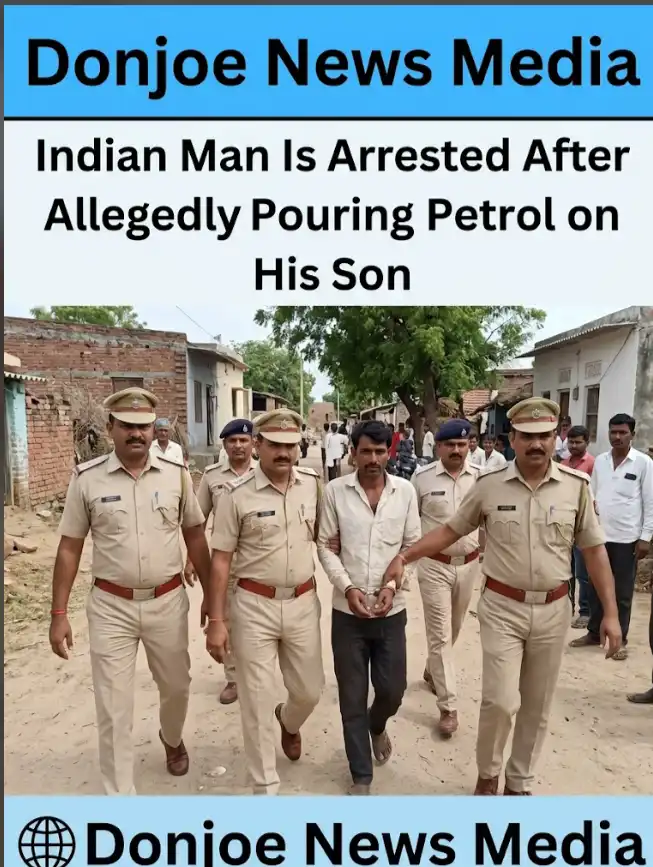
Published by Donjoe News Media | Dateline: Ravalvas, Suigam Taluka, Vav-Tharad District, Gujarat, India | Date: October 15, 2026
Unimaginable family tragedies often strike quiet rural towns without any prior warning. Specifically, an Indian man is arrested after allegedly pouring petrol on his son in Suigam, Gujarat, before secretly burying the toddler. Police officers in the Vav-Tharad district took the accused father, Ashok Rawal, into custody this week. According to investigators, Rawal doused his two-and-a-half-year-old son, Navghan, with fuel and ignited the flames. Subsequently, the father buried the child to hide the crime from local authorities. Readers tracking global crime news on www.donjoemedia.com can review the verified police findings below.
Initially, the suspect tried to disguise the toddler’s death as a sudden household accident. However, a close family relative uncovered the disturbing truth shortly after the burial. Consequently, that relative alerted law enforcement officers at the Suigam police station. Police teams then acted swiftly to recover the physical evidence. Therefore, investigators exhumed the young boy’s body from a local graveyard for a forensic autopsy.
Meanwhile, the brutal killing has left residents across northern Gujarat in deep shock. Neighbours still struggle to comprehend why a father would harm a defenseless toddler. According to a report by NDTV, the suspect viewed his young child as a heavy daily burden. Because his estranged wife lived separately, Rawal handled all childcare duties alone. Ultimately, that domestic resentment boiled over into fatal violence on Tuesday afternoon.
In addition, senior district police officials have filed two severe criminal charges against the father. Specifically, prosecutors booked Rawal for premeditated murder and the intentional destruction of evidence. Currently, forensic specialists are analyzing tissue samples to complete their official medical report. Meanwhile, our editorial desk at Donjoe News Media has compiled the full timeline, village details, and official police statements below.
Where the Crime Happened: Ravalvas Village and Suigam Local Government
First, readers must examine the exact geographic location to understand this investigation fully. Specifically, the deadly incident occurred in Ravalvas, a residential village locality inside Suigam town. Administratively, Suigam functions as a local government taluka headquarters in northern Gujarat. Furthermore, the town falls under the jurisdiction of the newly formed Vav-Tharad district. Historically, this border region formed part of the larger Banaskantha district near Rajasthan.
According to official police records, the attack happened on Tuesday, October 13, 2026. More precisely, detectives narrowed the crime window to between 1:00 PM and 2:00 PM local time. During that hot afternoon hour, most Ravalvas villagers stayed indoors to rest. Consequently, very few neighbours noticed any immediate disturbance coming from the Rawal compound. Moreover, the suspect remained completely alone with his young son inside the house.
Because Ravalvas is a tight-knit settlement, local families generally know one another well. Nevertheless, bitter domestic disputes inside private homes often stay hidden from public view. For instance, neighbours knew about the father’s ongoing marital separation. However, nobody expected that household tension to endanger a two-and-a-half-year-old boy. Therefore, the sudden death of little Navghan sent shockwaves through every street in Suigam taluka.
Soon after the murder came to light, local government officials joined the police inquiry. Specifically, the Suigam Mamlatdar stepped in to supervise mandatory legal procedures. In Gujarat’s local government system, the Mamlatdar serves as the head revenue and executive magistrate for the taluka. Additionally, Indian law requires an executive magistrate to authorize any graveyard exhumation. Thus, local government authorities and district police worked together from the very beginning.
Who Were Involved: Family Background and Marital Separation
Every accurate news report requires a clear profile of the people involved. First, police identified the arrested suspect as Ashok Rawal, also spelled Ashok Raval locally. Second, authorities named the victim as Navghan Rawal, the suspect’s two-and-a-half-year-old biological son. Third, investigators identified the whistleblower as Babubhai Rawal, who is Ashok’s paternal uncle. Notably, Babubhai also lives in the same Ravalvas locality of Suigam town.
According to a report in The Times of India, deep family trouble started months before Tuesday’s attack. Years ago, Ashok married a woman from Himmatnagar, a municipality in Gujarat’s Sabarkantha district. Initially, the couple lived together with their infant son in Suigam. However, frequent marital arguments gradually destroyed peace inside the home. As a result, the child’s mother left Suigam and returned to her parents in Himmatnagar.
Following that bitter split, the mother lived apart from Ashok for several months. Meanwhile, young Navghan stayed behind in Ravalvas under his father’s direct custody. Because no female caretaker lived in the home, Ashok managed all daily parenting tasks alone. According to police investigators, the father resented feeding, bathing, and watching the active toddler. Consequently, anger built up inside the household day after day.
Vav-Tharad Superintendent of Police C. J. Teraiya explained this motive clearly to journalists. Specifically, speaking with the Press Trust of India (PTI), SP Teraiya stated that Rawal viewed solo childcare as a burden. Instead of asking extended relatives for help, the father grew increasingly hostile toward the boy. Ultimately, police allege that this frustration drove Rawal to end his son’s life.
Afternoon of Horror: Timeline of the Petrol Attack and Hospital Visit
Detectives have now reconstructed the exact sequence of events from Tuesday, October 13. Between 1:00 PM and 2:00 PM, Ashok Rawal stayed inside his Ravalvas home with little Navghan. At that time, the father allegedly picked up a container filled with petrol. Next, he poured the flammable fuel directly over the two-and-a-half-year-old boy. Immediately afterward, Rawal struck a flame and set his toddler son on fire.
Within seconds, the petrol ignited and inflicted catastrophic burns across the child’s small body. Soon after lighting the blaze, however, the father altered his immediate behaviour. Specifically, Rawal doused the flames and lifted the critically injured boy. Subsequently, he rushed Navghan to a nearby hospital for emergency medical care. Investigators believe he staged this hospital trip to avoid immediate suspicion from village neighbours.
Upon arrival at the medical facility, emergency doctors examined the severely burned toddler. Sadly, the deep thermal injuries proved fatal. Consequently, attending physicians pronounced two-and-a-half-year-old Navghan dead shortly after admission. Under standard Indian medical rules, fatal burn injuries require an immediate police report and autopsy. Nevertheless, the father moved quickly to bypass those mandatory legal procedures.
Instead of waiting for police officers, Rawal took his son’s body out of the hospital. Furthermore, he never informed the Suigam police station about the fatal fire at his home. By removing the body immediately, the father hoped to prevent forensic doctors from finding petrol residue. As a result, a violent domestic assault quickly turned into a calculated criminal cover-up.
The Secret Burial: Attempting to Hide Crucial Forensic Evidence
After leaving the hospital, Ashok Rawal focused entirely on hiding the true cause of death. According to the formal police complaint, he contacted a few close relatives for help. Together, they prepared the toddler’s body for a rapid burial. Notably, in many Hindu communities across Gujarat, families bury toddlers instead of cremating them. Rawal used this local burial custom to dispose of the remains quickly without raising public suspicion.
Shortly after returning to Suigam, the group carried Navghan’s body to the local community burial ground. There, they dug a pit and buried the two-and-a-half-year-old boy. Throughout the entire process, the father kept local municipal officials completely in the dark. Moreover, he excluded extended relatives who might notice the smell of petrol on the body. Thus, by Tuesday evening, Rawal believed he had buried the crime forever.
However, hiding a sudden child death inside a small village like Ravalvas is nearly impossible. Before long, neighbours noticed that young Navghan was missing from the family courtyard. Additionally, quiet rumours spread through the neighbourhood about a hasty afternoon burial at the graveyard. When relatives asked questions, Ashok gave vague and conflicting answers about the boy’s sudden death. Consequently, deep suspicion grew among senior elders of the Rawal family.
Meanwhile, Suigam police officers are investigating the exact role of the relatives who attended the burial. Specifically, detectives want to know whether those assistants knew about the petrol attack beforehand. Alternatively, Rawal may have tricked them into believing the toddler died in an accidental kitchen fire. Either way, officials stated that anyone who knowingly hid the murder will face prosecution. Readers can follow updates on these arrests at www.donjoemedia.com.
How Uncle Babubhai Rawal Exposed the Murder to Suigam Police
The major breakthrough in the investigation came when the suspect’s uncle, Babubhai Rawal, uncovered the truth. Babubhai, also known locally as Babu Raval, lives near his nephew in Ravalvas. Soon after the secret burial, Babubhai heard alarming details about how little Navghan actually died. Specifically, he learned that Ashok had poured petrol on the toddler and set him ablaze. Furthermore, he confirmed that the father had buried the child without notifying authorities.
Shocked by the cruelty of the crime, Babubhai refused to shield his nephew from the law. Instead, the uncle chose truth and accountability over family ties. Consequently, Babubhai walked straight to the Suigam police station to file an official report. There, he met with station officers and recounted the entire sequence of events. Additionally, he explained how Ashok’s wife lived separately in Himmatnagar after prolonged marital fights.
Based on Babubhai’s formal statement, Suigam police officers registered a First Information Report (FIR). Under Indian law, the FIR officially launches a full criminal investigation. Immediately, station officers briefed Vav-Tharad Superintendent of Police C. J. Teraiya on the murder allegation. Because the suspect had already buried the child, detectives knew they had to move fast. Every hour underground risked damaging vital chemical evidence on the victim’s skin.
Undoubtedly, Babubhai Rawal’s brave decision stopped a brutal child murder from going unpunished. In many rural domestic crimes, family elders stay silent to avoid social shame. However, Babubhai’s prompt police complaint gave investigators the legal authority they needed to act. As a result, police teams mobilized rapidly to secure both the graveyard and the suspect.
Graveyard Exhumation, Forensic Autopsy, and Criminal Charges
Once officers recorded the FIR, recovering the toddler’s body became their top priority. However, Indian criminal procedure strictly regulates the opening of any grave. Specifically, police investigators must secure formal permission and supervision from a local executive magistrate. Therefore, Suigam police contacted the local government Mamlatdar immediately. The Mamlatdar promptly joined the police team and travelled to the Suigam community burial ground.
At the graveyard, family witnesses pointed out the fresh grave where little Navghan lay. Under the direct watch of the Mamlatdar and senior police officers, staff carefully dug up the soil. Soon after, the team exhumed the body of the two-and-a-half-year-old boy. Meanwhile, police videographers filmed the entire exhumation to maintain a strict evidentiary chain of custody. Officials also completed a formal site inquest report right beside the grave.
Following the exhumation, police transported the child’s remains to a government hospital for a forensic postmortem. There, medical examiners documented the severe burn injuries across the toddler’s body. Specifically, pathologists checked the windpipe for soot particles, which prove a person breathed during a fire. Furthermore, doctors preserved skin and tissue samples for chemical testing at a state forensic laboratory. Those laboratory tests detect petrol hydrocarbons even after burial.
Simultaneously, a second police team raided the suspect’s house in Ravalvas to examine the crime scene. Officers searched the rooms for the petrol bottle, matchsticks, and burned clothing fragments. Shortly afterward, police tracked down Ashok Rawal and arrested him. With the suspect in custody, prosecutors filed severe charges under India’s Bharatiya Nyaya Sanhita (BNS). Specifically, police charged Rawal with murder under Section 103 and destroying evidence under Section 238.
For readers of Donjoe News Media, here are the verified facts of the Suigam investigation:
- Arrested Suspect: Ashok Rawal (Ashok Raval), biological father of the victim.
- Victim: Navghan Rawal, a two-and-a-half-year-old boy.
- Time and Date: Tuesday, October 13, 2026, between 1:00 PM and 2:00 PM local time.
- Village and Local Government: Ravalvas locality, Suigam Town, Suigam Taluka, Vav-Tharad District, Gujarat, India.
- Key Whistleblower: Babubhai Rawal (Babu Raval), paternal uncle of the accused.
- Lead Officials: Vav-Tharad SP C. J. Teraiya, Suigam Police Station officers, and the Suigam Mamlatdar.
- Criminal Charges: Murder and causing the disappearance of evidence under the Bharatiya Nyaya Sanhita (BNS).
Community Grief in Gujarat and the Need for Child Protection
Across Suigam taluka, the arrest of Ashok Rawal has triggered widespread grief and outrage. Local villagers told reporters that a two-and-a-half-year-old child deserves unconditional care and safety. Instead, young Navghan suffered an agonizing death inside his own home. In Ravalvas, shocked neighbours gathered along the narrow lane as police officers patrolled the area. Meanwhile, community leaders praised Babubhai Rawal for reporting the crime to police.
Beyond the immediate police investigation, child welfare experts point to critical warning signs in this case. Specifically, when marriages collapse, vulnerable toddlers often suffer the worst consequences. Here, after the mother moved to Himmatnagar, the father clearly lacked the patience to parent alone. Rather than handing the boy over to his mother or grand-uncles, Rawal kept the child in an angry home.
Therefore, social workers urge extended families to monitor young children closely during bitter marital separations. Whenever a single parent shows signs of extreme hostility or burnout, relatives must step in immediately. Furthermore, citizens across India can report child abuse at any hour by calling the national Childline helpline at 1098. Timely action by neighbours or family members can save a child’s life before anger turns fatal.
Next, Suigam police will present Ashok Rawal before a district magistrate to request custodial remand. During remand, detectives will trace where he acquired the petrol and question hospital witnesses. Additionally, officers will record a formal statement from the child’s mother in Himmatnagar. Once forensic laboratories deliver the final chemical reports, prosecutors will file a complete charge sheet for trial.
Also read Mass Shooting Plot Foiled at US Hindu Temple India:
Thank you for reading this investigative newsletter from Donjoe News Media. Our editorial team remains dedicated to delivering verified, human-centered, and accurate journalism from around the world. For more breaking crime coverage, legal updates, and special reports, visit www.donjoemedia.com today.

Pingback: Jio Announces India's Biggest-Ever IPO: - Donjoe Media